(March 2013)
| Francis | |
|---|---|
 | |
| Papacy began | 13 March 2013 |
| Predecessor | Benedict XVI |
| Orders | |
| Ordination | 13 December 1969 by Ramón José Castellano |
| Consecration | 27 June 1992 by Antonio Quarracino |
| Created Cardinal | 21 February 2001 |
| Personal details | |
| Birth name | Jorge Mario Bergoglio |
| Born | 17 December 1936 Buenos Aires, Argentina |
| Nationality | Argentina, Vatican City |
| Previous post | Auxiliary Bishop of Buenos Aires (1992–1997) Titular Bishop of Auca (1992–1997) Archbishop of Buenos Aires (1998–2013) Cardinal-Priest of St. Roberto Bellarmino (2001–2013) Ordinary of the Ordinariate for the Faithful of the Eastern Rites in Argentina (1998–2013) |
| Motto | Miserando atque eligendo ("With mercy and choosing")[1] |
| Coat of arms |  |
| Papal styles of Pope Francis | |
|---|---|
 | |
| Reference style | His Holiness |
| Spoken style | Your Holiness |
| Religious style | Holy Father |
A native of Buenos Aires, Argentina, Bergoglio was ordained as a priest in 1969. From 1998 until 2013, he served as the Archbishop of Buenos Aires, and Pope John Paul II made him a cardinal in 2001. Elected as pope in 2013 following his predecessor Pope Benedict XVI's resignation, Bergoglio chose "Francis" as his name. This marked the first time in papal history that this name had been used, and along with Pope John Paul I is one of only two times since Pope Lando's brief 913 reign that a serving pope held a name unused by a predecessor. Francis is both the first Jesuit priest and the first native of the Americas to be elected Pope. He is also the first non-European pope since Syrian-born Pope Gregory III, who died in 741.
Contents[hide] |
Early life
Jorge Mario Bergoglio[4] was born in Buenos Aires, one of the five children of Italian immigrants[3][5] Mario José Bergoglio, a railway worker, and his wife Regina María Sívori, a housewife. As a teenager, Bergoglio had a lung removed as a result of an infection.[6] He studied and received a master's degree in chemistry at the University of Buenos Aires before he decided to pursue an ecclesiastical career.[7] According to another reference, he graduated from a technical school as a chemical technician and at the age of 21 decided to become a priest.[8]Ecclesiastical career
Jesuit
Bergoglio entered the Society of Jesus on 11 March 1958 and studied to become a priest at the Jesuit seminary in Villa Devoto. In 1960, Bergoglio obtained a licentiate in philosophy from the Colegio Máximo San José in San Miguel; in 1964 and 1965, he taught literature and psychology at the Colegio de la Inmaculada, a high school in the province of Santa Fe, Argentina, and in 1966 he taught the same courses at the Colegio del Salvador in Buenos Aires.[9]In 1967, Bergoglio finished his theological studies and was ordained to the priesthood on 13 December 1969, by Archbishop Ramón José Castellano. He attended the Facultades de Filosofía y Teología de San Miguel (Philosophical and Theological Faculty of San Miguel),[10] a seminary in San Miguel, Buenos Aires province. Bergoglio attained the position of novice master there and became professor of theology.
The Society of Jesus promoted Bergoglio and he served as provincial for Argentina from 1973 to 1979.[11] He was transferred in 1980 to become the rector of the seminary in San Miguel, and served in that capacity until 1986. He completed his doctoral dissertation in Germany and returned to Argetina to serve as confessor and spiritual director in Córdoba.[9]
Bishop
Bergoglio was named Auxiliary Bishop of Buenos Aires in 1992 and was ordained on 27 June 1992 as Titular Bishop of Auca,[12] with His Eminence, Antonio Cardinal Quarracino, Archbishop of Buenos Aires, serving as principal consecrator.Bergoglio succeeded Cardinal Quarracino as Archbishop of Buenos Aires on 28 February 1998 and was concurrently named ordinary for Eastern Catholics in Argentina, who had lacked their own prelate.
Cardinal

- Member of the Congregation for Divine Worship and the Discipline of the Sacraments
- Member of the Congregation for the Clergy
- Member of the Congregation for Institutes of Consecrated Life and Societies of Apostolic Life
- Member of the Pontifical Council for the Family
- Member of the Commission for Latin America
On the death of Pope John Paul II, Bergoglio was considered one of the papabile cardinals[citation needed]. He participated as a cardinal elector in the 2005 papal conclave that selected Pope Benedict XVI. La Stampa reported that Bergoglio was in close contention with Ratzinger during the election, until he made an emotional plea[15] that the cardinals should not vote for him.[16] Earlier, he had participated in the funeral of Pope John Paul II and acted as a regent alongside the College of Cardinals, governing the Holy See and the Roman Catholic Church during the interregnum sede vacante period.
During the 2005 Synod of Bishops, he was elected a member of the Post-Synodal council. Catholic journalist John L. Allen, Jr. reported that Bergoglio was a frontrunner in the 2005 Conclave. An unauthorized diary of uncertain authenticity released in September 2005[17] confirmed that Bergoglio was the runner-up and main challenger of Cardinal Ratzinger at that conclave. The purported diary of the anonymous cardinal claimed Bergoglio received 40 votes in the third ballot, but fell back to 26 at the fourth and decisive ballot[18] .
On 8 November 2005, Bergoglio was elected President of the Argentine Episcopal Conference for a three-year term (2005–2008) by a large majority of the Argentine bishops, which according to reports confirms his local leadership and the international prestige earned by his alleged performance in the conclave. He was reelected on 11 November 2008.
As a cardinal, Bergoglio was associated with Communion and Liberation, a conservative Catholic association of the faithful.[19]
Relations with the Argentine government

According to the book, after their release, Yorio accused the then-Provincial of his Jesuit order San Miguel, Jorge Mario Bergoglio, to have denounced him. Father General Pedro Arrupe in Rome was informed by letter or during the abduction, both he and Orlando Yorio were excluded from the Jesuit Order.[24]
Bergoglio told his authorized biographer, Sergio Rubin, that after the priests' imprisonment, he worked behind the scenes for their release; Bergoglio's intercession with dictator Jorge Rafael Videla on their behalf may have saved their lives.[25] "The cardinal could not justify why these two priests were in a state of helplessness and exposed," according to Luis Zamora, who said that Bergoglio's testimony "demonstrates the role of the Church during the last military dictatorship."[26]
In 2010, Bergoglio told Sergio Rubin that he often sheltered people from the dictatorship on church property, and on one occasion gave his identity papers to a man who looked like him, to enable the recipient to flee Argentina.[27]
Bergoglio stated that adoption by same-sex couples is a form of discrimination against children. This position received a rebuke from Argentine president Cristina Fernández de Kirchner, who said the church's tone was reminiscent of "medieval times and the Inquisition."[28]
As detailed below, on presenting the Aparecida Document Bergoglio, in addition to commenting on social problems, exhorted "legislators, heads of government, and health professionals" to act according to conservative Catholic principles regarding abortion and other issues and said that "people cannot receive Holy Communion and at the same time ... [commit] serious crimes against life and family. This responsibility applies particularly to legislators, governors, and health professionals." He referred to a topical Argentine abortion case. Argentina's government opposed this: Human Rights Undersecretary of Buenos Aires, Guillermo Guerin said that "the diagnosis of the Church in relation to social problems in Argentina is correct, but to mix that with abortion and euthanasia, is at least a clear example of ideological malfeasance."[29]
Papacy
 |
| This article is part of the series: Politics and government of the Holy See |

On the day of his election, the Vatican clarified that his official papal name was Francis, not "Francis I." A Vatican spokesman said that the name would become Francis I if and when there is a Francis II.[39]
Bergoglio is the first Jesuit priest chosen to be pope.[40] He is also the first pope from the Americas, the New World, and the Southern Hemisphere. He is the first non-European pope in 1,272 years. The last non-European pope, St. Gregory III, was born in Syria and reigned from 731 to 741.[41]
At the time of his election, Francis was fluent in Spanish (his mother tongue), Latin, Italian, and German.[42]
As noted earlier, Cardinal Bergoglio's strong popularity amongst the other cardinals had been brought to notice once before in the 2005 Conclave in which Pope Benedict XVI was elected, and in which Cardinal Bergoglio had received the second largest share of votes after Cardinal Ratzinger [16]
Positions on moral and political issues
Poverty and economic inequality
On 30 September 2009, Bergoglio spoke at a conference organized by the Argentina City Postgraduate School (EPOCA) at the Alvear Palace Hotel titled "Las deudas sociales de nuestro tiempo" ("The Social Debts of Our Time") in which he quoted the 1992 "Documento de Santo Domingo"[43] by the Latin American Episcopal Conference, saying "extreme poverty and unjust economic structures that cause great inequalities" are violations of human rights.[44][45] He went on to describe social debt as "immoral, unjust and illegitimate".[46]During a 48-hour public servant strike in Buenos Aires, Argentina, Bergoglio observed the differences between "poor people who are persecuted for demanding work, and rich people who are applauded for fleeing from justice."[47] During a May 2010 speech in Argentina regarding the poor, he directed his message to the wealthy by saying: "You avoid taking into account the poor. We have no right to duck down, to lower the arms carried by those in despair. We must reclaim the memory of our country who has a mother, recover the memory of our Mother".[48]
The vulnerable in society
In 2007, Bergoglio denounced what he characterized as a cultural tolerance of child abuse and "discarding of the elderly". He spoke strongly against the abuse of children as "demographic terrorism," and decried their exploitation. "Children are mistreated, and are not educated or fed. Many are made into prostitutes and exploited," and against a "culture of discarding" the elderly and treating them as if they are disposable and worthless due to their advanced age.[29]Doctrinal compliance on abortion and euthanasia
In 2007, as Cardinal Archbishop of Buenos Aires, Bergoglio presented the final version of a joint statement of the bishops of Latin America – the "Aparecida Document" – upon its approval by Pope Benedict XVI. The document links worthiness to receive the Eucharist, to compliance and acceptance of Church teaching against "abominable crimes" such as abortion and euthanasia:[29][49][50][51]- "We hope that legislators, heads of government, and health professionals, conscious of the dignity of human life and of the rootedness of the family in our peoples, will defend and protect it from the abominable crimes of abortion and euthanasia; that is their responsibility ... We should commit ourselves to 'eucharistic coherence', that is, we should be conscious that people cannot receive Holy Communion and at the same time act or speak against the commandments, in particular when abortion, euthanasia, and other serious crimes against life and family are facilitated. This responsibility applies particularly to legislators, governors, and health professionals."
Homosexuality
Bergoglio has affirmed church teaching on homosexuality specifically that homosexual actions are immoral.[54][55] He opposes same-sex marriage,[56] but unsuccessfully opposed legislation introduced in 2010 to allow same-sex marriage in Argentina, calling it a "real and dire anthropological throwback."[57] In a letter to the monasteries of Buenos Aires, he wrote: "Let's not be naïve, we're not talking about a simple political battle; it is a destructive pretension against the plan of God. We are not talking about a mere bill, but rather a machination of the Father of Lies[58] that seeks to confuse and deceive the children of God."[59] Bergoglio has also stated that adoption by same-sex couples is a "form of discrimination against children."[60]Bibliography
Books
Jorge Bergoglio; Abraham Skorka (2010) (in Spanish). Sobre el cielo y la tierra [On Heaven and Earth]. Buenos Aires: Editorial Sudamericana. ISBN 9789500732932.[61]Writings
- Meditaciones para religiosos [Meditations for the Religious] (1982)
- Reflexiones sobre la vida apostólica [Reflections on Apostolic Life] (1986)
- Reflexiones de esperanza [Reflections of Hope] (1992)
- Diálogos entre Juan Pablo II y Fidel Castro [Dialogues Between John Paul II and Fidel Castro] (1998)
- Educar: exigencia y pasión [To Educate: Exactingness and Passion] (2003)
- Ponerse la patria al hombro [Putting the Motherland on One's Shoulders] (2004)
- La nación por construir [The Nation to Be Built] (2005)
- Corrupción y pecado [Corruption and Sin] (2006)
- Sobre la acusación de sí mismo [On Self-Accusation] (2006)
- El verdadero poder es el servicio [True Power Is Service] (2007)
- Mente abierta, corazón creyente [Open Mind, Believing Heart] (2012)
Notes

- ^ Pronunciation: [ˈxorxe ˈmaɾjo βerˈɣoɣljo] (Spanish), [berˈgoʎʎo] (Italian).
References
- ^ The phrase is drawn from a homily of Bede: "Vidit ergo Iesus publicanum, et quia miserando atque eligendo vidit, ait illi, Sequere me." "Jesus looked at the publican, and because he looked with mercy and choosing, said to him, 'Follow me.'" preso da: Miserando atque eligendo: il motto di Papa Francesco.
- ^ John A. Hardon's Modern Catholic Dictionary (1980) lists Pope John Paul II (1978–2005) as 264th pope, making Pope Benedict XVI the 265th and Francis the 266th
- ^ a b Rice-Oxley, Mark (13 March 2013). "Pope Francis: the humble pontiff with practical approach to poverty". The Guardian (UK). http://www.guardian.co.uk/world/2013/mar/13/jorge-mario-bergoglio-pope-poverty. Retrieved 13 March 2013.
- ^ "College of Cardinals Biographical notes". Vatican.va. http://www.vatican.va/news_services/press/documentazione/documents/cardinali_biografie/cardinali_bio_bergoglio_jm_en.html. Retrieved 2013-03-14.
- ^ "Argentina's Cardinal Bergoglio Is Elected Pope Francis". Bloomberg. 13 March 2013. http://www.bloomberg.com/news/2013-03-13/argentina-s-cardinal-jorge-bergoglio-is-elected-pope-francis-i.html. Retrieved 13 March 2013.
- ^ "New Pope, Francis, Known As Humble Man with a Focus on Social Outreach". CBS New York (CBS Local Media). 13 March 2013. http://newyork.cbslocal.com/2013/03/13/cardinal-jorge-bergoglio-of-argentina-voted-new-pope-of-the-catholic-church/. Retrieved 2013-03-13.
- ^ Rocca, Francis X (13 March 2013). "Cardinal Jorge Bergoglio: a profile". Catholic Herald. http://www.catholicherald.co.uk/news/2013/03/13/cardinal-bergoglio-profile/. Retrieved 13 March 2013.
- ^ La Nación newspaper: Jorge Bergoglio, a career Jesuit priest, 13 March 2013 (Spanish) Article gives detail: he graduated from industrial secondary school E.N.E.T Nº 27 "Hipólito Yrigoyen".
- ^ a b "Pope Francis : Cardinal Jorge Mario Bergoglio named new Pope". Baltimore News Journal. 13 March 2013. http://www.baltimorenewsjournal.com/2013/03/13/pope-francis-i-cardinal-jorge-mario-bergoglio-named-new-pope/. Retrieved 13 March 2013.
- ^ Official Website, Facultades de Filosofía y Teología de San Miguel
- ^ [1], Catholic.org
- ^ The titular see of Auca, established in 1969, is seated at Villafranca Montes de Oca, Spain: Titular See of Auca, Spain.
- ^ McCarthy, John (3 March 2013). "Profile: New pope, Jesuit Bergoglio, was runner-up in 2005 conclave". Ncronline.org. http://ncronline.org/blogs/ncr-today/papabile-day-men-who-could-be-pope-13. Retrieved 2013-03-13.
- ^ "'Toward The Conclave Part III: The Candidates'". 18 April 2005. http://cablegatesearch.net/cable.php?id=05VATICAN466. Retrieved 2012-03-13.
- ^ "Quasi in lacrime" (almost in tears)
- ^ a b "Ecco come andò davvero il Conclave del 2005 lastampa.it (Italian)". La Stampa. http://vaticaninsider.lastampa.it/vaticano/dettaglio-articolo/articolo/conclave-22761/. Retrieved 2013-03-13.
- ^ "Cardinal breaks conclave vow of secrecy". Associated Press. CNN. 23 September 2005. Archived from the original on 1 October 2005. http://web.archive.org/web/20051001062114/http://www.cnn.com/2005/WORLD/europe/09/23/conclave.diary.ap/index.html. Retrieved 13 March 2013.
- ^ Catholic News: Article based on diary says German cardinal became pope with 84 votes, 23 September 2005 Article gives numbers for the four votes; Ratzinger had most votes, followed by Bergoglio.
- ^ Allen, Jr., John L. (3 March 2013). "Who Is Cardinal Jorge Mario Bergoglio? (renamed Profile: New pope, Jesuit Bergoglio, was runner-up in 2005 conclave)". National Catholic Reporter. http://ncronline.org/blogs/ncr-today/papabile-day-men-who-could-be-pope-13. Retrieved 13 March 2013.
- ^ "Los Angeles Times: Argentine Cardinal Named in Kidnap Lawsuit, 17 April 2005". Los Angeles Times. 17 April 2005. http://articles.latimes.com/2005/apr/17/world/fg-cardinal17. Retrieved 2013-03-13.
- ^ Peter Macdiarmid/Getty Images (1 November 2011). "Pope Francis: A look at the life of the first South American pontiff The Associated Press March 13, 2013". The Star-Ledger. http://www.nj.com/news/index.ssf/2013/03/pope_francis_a_look_at_the_lif.html. Retrieved 2013-03-13.
- ^ The Silence: from Paulo VI to Bergoglio: secret relations of the Church with the ESMA, Sudamericana (Bs. As.), 2005. ISBN 950-07-2035-3
- ^ "The sins of the Argentinian church | Hugh O'Shaughnessy | Comment is free". guardian.co.uk. 2008-05-29. http://www.guardian.co.uk/commentisfree/belief/2011/jan/04/argenitina-videla-bergoglio-repentance. Retrieved 2013-03-14.
- ^ Horacio Verbitsky: Los signos del cardenal. In: Página/12, 2. Mai 2010. Abgerufen am 1. Januar 2011.
- ^ "Pope Francis Is Known For Simplicity And Humility". Associated Press. 13 March 2013. http://www.npr.org/templates/story/story.php?storyId=174220195. Retrieved 13 March 2013. "both men were freed after Bergoglio took extraordinary, behind-the-scenes action to save them – including persuading dictator Jorge Videla's family priest to call in sick so that he could say Mass in the junta leader's home, where he privately appealed for mercy."
- ^ "Bergoglio declared missing by priests NATION November 9, 2010". Lanacion.com.ar. http://www.lanacion.com.ar/1323041-bergoglio-declaro-por-los-sacerdotes-desaparecidos. Retrieved 2013-03-13.
- ^ "Pope Francis Is Known For Simplicity And Humility". Associated Press. 13 March 2013. http://www.npr.org/templates/story/story.php?storyId=174220195. Retrieved 13 March 2013. "Bergoglio – who ran Argentina's Jesuit order during the dictatorship – told Rubin that he regularly hid people on church property during the dictatorship, and once gave his identity papers to a man with similar features, enabling him to escape across the border."
- ^ Allen, Jr., John L. (3 March 2013). "Papabile of the Day: The Men Who Could Be Pope". National Catholic Reporter. http://ncronline.org/blogs/ncr-today/papabile-day-men-who-could-be-pope-13. Retrieved 13 March 2013.
- ^ a b c Hoffman, Matthew Cullinan (2007-10-05). "Cardinal Archbishop of Buenos Aires Rages Against Abortion "Death Sentence"". LifeSiteNews. http://www.lifesitenews.com/news/archive//ldn/2007/oct/07100509. Retrieved 13 March 2013.
- ^ "FRANCISCUS". Holy See. 13 March 2013. Archived from the original on 13 March 2013. http://www.webcitation.org/6F60wLVTO. "Annuntio vobis gaudium magnum; habemus Papam: Eminentissimum ac Reverendissimum Dominum, Dominum Georgium MariumSanctae Romanae Ecclesiae Cardinalem Bergoglioqui sibi nomen imposuit Franciscum"
- ^ Habemus Papam! Cardinal Bergolio Elected Pope - Fracis I
- ^ "Cardinal Jorge Mario Bergoglio of Argentina Named as New Pope of the Roman Catholic Church". CNBC. 13 March 2013. http://www.cnbc.com/id/100538976. Retrieved 13 March 2013.
- ^ Michael Martinez, CNN Vatican analyst: Pope Francis' name choice 'precedent shattering', CNN (13 March 2013). Retrieved 13 March 2013.
- ^ David Batty. "Pope named after Francis of Assisi heralded by gull atop Sistine chimney | World news". The Guardian. http://www.guardian.co.uk/world/2013/mar/13/pope-francis-assisi-seagull-sistine. Retrieved 2013-03-13.
- ^ "Argentina's Bergoglio becomes Pope Francis – This Just In - CNN.com Blogs". News.blogs.cnn.com. http://news.blogs.cnn.com/2013/03/13/cardinals-elect-new-pope/. Retrieved 2013-03-14.
- ^ "Cardinal Dolan Talks About The Choice Of Pope Francis". CBS 2 News. WCBS-TV. 13 March 2013. http://newyork.cbslocal.com/video/8616695-cardinal-dolan-talks-about-the-choice-of-pope-francis/. Retrieved 13 March 2013.
- ^ Rice-Oxley, Mark. "Pope Francis: the humble pontiff with practical approach to poverty". The Guardian. Guardian News and Media Limited. http://www.guardian.co.uk/world/2013/mar/13/jorge-mario-bergoglio-pope-poverty. Retrieved 13 March 2013.
- ^ Glauber, Bill. "Pope's name may connect to Jesuit roots - not Francis of Assisi". JSOnline. Journal Interactive Milwaukee. http://www.jsonline.com/features/religion/popes-name-may-connect-to-jesuit-roots--not-francis-of-assisi-i3958ss-197865021.html. Retrieved 13 March 2013.
- ^ Emily Alpert, Vatican: It's Pope Francis, not Pope Francis I, Los Angeles Times (13 March 2013). Retrieved 13 March 2013.
- ^ "Argentina's Jorge Mario Bergoglio elected Pope". BBC News. 13 March 2013. http://www.bbc.co.uk/news/world-europe-21777494. Retrieved 13 March 2013.
- ^ "New Pope is an Argentine". Financial Times. 13 March 2013. http://blogs.ft.com/beyond-brics/2013/03/13/snap-new-pope-is-an-argentine/. Retrieved 13 March 2013.
- ^ "Pope Francis: 13 key facts about the new pontiff". The Guardian. 13 March 2013. http://www.guardian.co.uk/world/2013/mar/13/new-pope-thirteen-key-facts. Retrieved 13 March 2013.
- ^ Latin American Episcopal Conference (1992). "Documento de Santo Domingo" (in Spanish) (PDF). Nueva evangelización, promoción humana, cultura cristiana : documento de consulta : IV Conferencia General del Episcopado Latinoamericano, Santo Domingo, República Dominicana, 1992, Conclusiones [Santo Domingo Document]. Cuarta Conferencia General del Episcopado Latinoamericano. Bogotá: CELAM. OCLC 29289158. http://www.celam.org/conferencias/Documento_Conclusivo_Santo_Domingo.pdf. Retrieved 9 March 2013.
- ^ Bergoglio, Jorge Mario (30 September 2009) (in Spanish). Seminario : las deudas sociales de nuestro tiempo : la deuda social según la doctrina de la iglesia [Seminar : social debts of our time : the social debt according to the doctrine of the church] (presented seminar). Posgrado internacional del bicentenario. Políticas públicas, soluciones para la crisis de nuestro tiempo.. Buenos Aires: EPOCA-USAL. OCLC 665073169.
- ^ Rouillon, Jorge (1 October 2009). "Bergoglio: "Los derechos humanos también se violan con la pobreza" [Bergoglio: "Human rights are also violated in poverty"]" (in Spanish). La Nación. http://www.lanacion.com.ar/1181036-bergoglio-los-derechos-humanos-tambien-se-violan-con-la-pobreza. Retrieved 9 March 2013. "Citó a los obispos latinoamericanos que en 1992 dijeron que "los derechos humanos se violan no sólo por el terrorismo, la represión, los asesinatos, sino también por condiciones de extrema pobreza y estructuras económicas injustas que originan grandes desigualdades"."
- ^ "Extreme poverty is also a violation of human rights, says Argentinean cardinal". Catholic News Agency. 1 October 2009. http://www.catholicnewsagency.com/news/extreme_poverty_is_also_a_violation_of_human_rights_says_argentinean_cardinal/. Retrieved 13 March 2013.
- ^ "Argentines protest against pay cuts". 8 August 2001. http://news.bbc.co.uk/2/hi/americas/1481313.stm. Retrieved 13 March 2013.
- ^ "Bergoglio criticó a "los que no tienen en cuenta a los más pobres"". lanacion.com. http://www.lanacion.com.ar/1262602-bergoglio-critico-a-los-que-no-tienen-en-cuenta-a-los-mas-pobres. Retrieved 2013-03-13.
- ^ Pope Benedict XVI (29 June 2007). "LETTER OF HIS HOLINESS BENEDICT XVI TO THE BISHOPS OF LATIN AMERICA AND THE CARIBBEAN (Aparecida Document)". http://www.aecrc.org/documents/Aparecida-Concluding%20Document.pdf. Retrieved 13 March 2013. - para. 436
- ^ "Aparecida Document Sent to Pontiff". Zenit.org. http://www.zenit.org/en/articles/aparecida-document-sent-to-pontiff. Retrieved 2013-03-13.
- ^ "New Pope Francis Called Abortion the 'Death Penalty for the Unborn'". LifeNews.com. http://www.lifenews.com/2013/03/13/new-pope-francis-called-abortion-the-death-penalty-for-the-unborn/. Retrieved 2013-03-13.
- ^ "Le cardinal Bergoglio invite à défendre la culture de la vie avec ardeur". Zenit.org. http://zenit.org/article-21867?l. Retrieved 2013-03-13.
- ^ Argentina's Bergoglio Becomes Pope Francis CNN News, 13 March 2013
- ^ Catholic Online. "NEW POPE: Who is this man named Bergoglio? – Living Faith – Home & Family – Catholic Online". Catholic.org. http://www.catholic.org/hf/faith/story.php?id=50111. Retrieved 2013-03-13.
- ^ "Catechism of the Catholic Church – The sixth commandment". Vatican.va. 29 October 1951. http://www.vatican.va/archive/ccc_css/archive/catechism/p3s2c2a6.htm. Retrieved 2013-03-13.
- ^ "Para Bergoglio, la ley de matrimonio gay es 'una movida del Diablo' –". Infobae.com. 30 January 2011. http://www.infobae.com/notas/525351-Para-Bergoglio-la-ley-de-matrimonio-gay-es-039una-movida-del-Diablo039.html. Retrieved 2013-03-13.
- ^ Padgett, Tim (18 July 2010). "The Vatican and Women: Casting the First Stone". Time. http://www.time.com/time/nation/article/0,8599,2004702,00.html. Retrieved 13 March 2013.
- ^ The devil
- ^ Goñi, Uki (15 July 2010). "Defying Church, Argentina Legalizes Gay Marriage". http://www.time.com/time/world/article/0,8599,2004036,00.html. Retrieved 13 March 2013.
- ^ Meet the new pope: Francis is humble leader who takes the bus to work by Erin McClam. NBC News, 13 March 2013
- ^ Jorge Mario Bergoglio; Abraham Skorka (1 December 2010). Sobre el cielo y la tierra / On Heaven and Earth. Random House Mondadori. ISBN 978-950-07-3293-2. http://books.google.com/books?id=xMetuAAACAAJ. Retrieved 14 March 2013.
External links
| Images | |
|---|---|
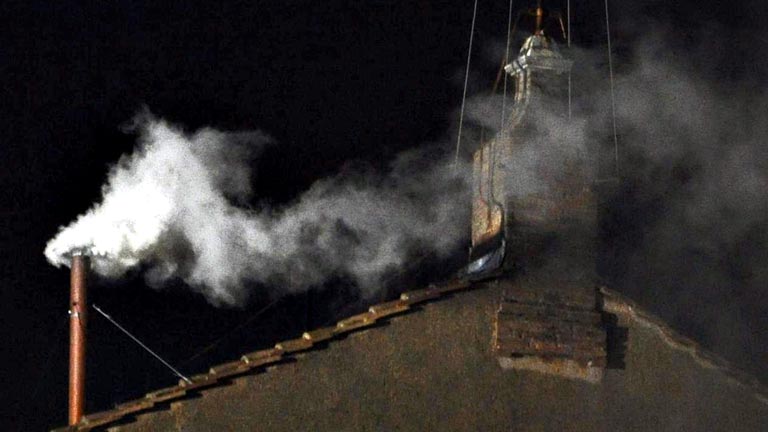
 Fumata Blanca Fumata Blanca | |
| Video | |
 Habemus Papam on YouTube Habemus Papam on YouTube | |
| First speech on YouTube |
 External media
Media related to Franciscus at Wikimedia Commons
- Vatican: the Holy See – Vatican web site (Archived at WebCite)
| Catholic Church titles | ||
|---|---|---|
| Preceded by Antonio Quarracino | Archbishop of Buenos Aires 1998–2013 | Vacant |
| Preceded by Benedict XVI | Pope 2013–present | Incumbent |
| ||
| |||


| ||
|
Categories:
- Current events from March 2013
- 1936 births
- 21st-century Roman Catholic archbishops
- Archbishops of Buenos Aires
- Argentine Jesuits
- Argentine people of Italian descent
- Argentine popes
- Cardinals created by Pope John Paul II
- Jesuit popes
- Jesuit theologians
- Living people
- People from Buenos Aires
- Pope Francis
- Popes
- Sovereigns of Vatican City
- University of Buenos Aires alumni
- Argentine chemists


 E' fumata bianca, papa eletto Sarà l'astigiano Bergoglio?